

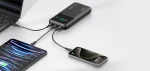
Power banks have grown to be a significant aspect of our life in this digital age. The most popular devices for charging smartphones, tablets, earphones, and other portable electronics are power banks.
Power bank: Power banks have become an essential part of our lives in the current digital era. The most popular device for charging smartphones, tablets, earphones, and other portable electronics is the power bank. However, a lot of people are unaware that this seemingly insignificant gadget can occasionally be lethal. It can result in mishaps like explosions or fires if not used correctly or if the incorrect kind of power bank is bought. There have been numerous instances where power banks have caused serious mishaps.
A plane recently escaped a serious accident.
According to the information, a power bank that was in a passenger’s carry-on luggage is thought to have been the source of a recent fire incident that occurred on a Virgin Australia flight from Sydney to Hobart. The airline is thinking about revising its battery-related policy in light of this incident.
On Monday, smoke was observed emerging from the overhead locker of Virgin flight VA1528 as it was landing at Hobart Airport. The overhead storage was the source of the fire, according to an airline representative. While other passengers attempted to assist with water bottles, a flight attendant was seen in a video posted by online news outlet Pulse Tasmania deploying a fire extinguisher on a bag full of smoke.
When does a power bank start to pose a risk?
First and foremost, it’s critical to realize that power banks are made of lithium-ion or lithium-polymer batteries, which have the potential to explode or catch fire in the event of overheating or a wiring malfunction. Power banks that are local or unbranded are frequently sold for extremely low prices, but their quality is uncontrolled. They lack circuit protection to stop overcharging, short circuiting, or heating, which raises the danger even further.

In addition, if the power bank is stored in a humid environment or exposed to sunlight for an extended period of time, it may intensify the chemical reaction within the battery, raising the risk of an explosion. Frequently, users abuse the same charging cable by charging the phone and power bank simultaneously, which can harm the phone and deplete the power bank’s capacity.
How can a power bank be used safely?
First and foremost, always purchase branded and BIS (Bureau of Indian Standards) certified power banks. These gadgets have safeguards against short circuits, overcharging, and overheating. Never charge the power bank more than is necessary, and after it is finished charging, unplug it from the power source.
The power bank should never be kept in extremely hot or cold environments. When traveling, it can be risky to leave the power bank in a locked automobile or in direct sunlight. When charging, avoid placing the device behind a pillow or mattress since this will block the heat from escaping, increasing the risk of a fire.
Always use a high-quality charging cable and adapter since a low-quality cable may result in a power bank short circuit or excessive current. Additionally, stop using the power bank right away and dispose of it at an e-waste recycling facility if it begins to smell like it’s burning, swells, or emits smoke.
Read More: AIIMS NORCET 9 2025 Applications Now Open
|
|
 Facebook Page Facebook Page |
Click Here |
| Twitter |
Click Here |
| Instagram |
Click Here |